I have three young kids, and college funding is already on my mind. Not because college is an imminent for my family -- I've (luckily) still got years to plan for it. But even with the benefit of time to save, the numbers are daunting. And I know that not everyone has that luxury. Lots of people find themselves staring down at a college acceptance letter and feeling a weird mix of emotions. Excited, sure. But that's also the moment the price tag becomes real, too. And they think to themselves, oh crap. How am I actually gonna pay for this?
One thing I keep coming back to is scholarships. Not the dream scenario of a single full ride -- that's rarely available even for outstanding students anymore -- but the reality of stacking multiple smaller awards that together make a real dent.
My niece and nephew are currently in school. I've got friends with older kids facing down college in the next few years. And I can tell you that the families I see actually pull this off aren't necessarily the ones submitting the most applications. They're the ones submitting the right ones.
Here's what that actually looks like.

Why Most Scholarship Searches Fail Before They Start
The internet will tell you there's "billions of dollars in unclaimed scholarship money" sitting out there waiting for any student to grab. This is misleading at best. Most of those funds have specific eligibility criteria that exclude the vast majority of applicants — a particular major, heritage, geographic area, employer affiliation, or GPA threshold. The money isn't unclaimed because no one applied; it's because not enough eligible candidates applied, or the pool was small by design.
The implication for students is important: applying broadly to scholarships you don't closely match is not a strategy. It's noise. The smarter move is identifying the scholarships where your specific profile — your background, your interests, your intended major, your community — makes you a genuinely strong fit. That narrower pool is where you actually have a chance.
Where to Actually Find Scholarships Worth Applying To
Most students start with the big aggregator sites — Fastweb, Scholarships.com, College Board's BigFuture Scholarship Search — and these are fine places to start. But the highest-value, lowest-competition scholarships often live somewhere else entirely.
Local scholarships are consistently underutilized. Your state's community foundation, your county's charitable trusts, local Rotary clubs, credit unions, chambers of commerce, and even local businesses often award scholarships with applicant pools that might number in the dozens rather than the thousands. A $1,000 local scholarship with 30 applicants is a far better use of your time than a $5,000 national scholarship with 50,000 applicants.
Employer and union affiliations are another overlooked category. Many large employers — and a surprising number of unions and professional associations — offer scholarships to employees' children. Check whether either parent's employer has a scholarship program. These are often undersubscribed because employees simply don't know they exist.
Your intended college's own scholarships deserve serious attention. Most institutional aid isn't automatic — students have to apply for it separately, and many don't. Contact the financial aid office directly and ask what merit scholarships require separate applications. Make sure you're also filling out the FAFSA correctly — a mistake there can affect your eligibility for need-based awards that stack with merit scholarships. If you're unsure where to start, our FAFSA tips break down the basics, and our guide on the right way to fill out the FAFSA walks through the 2026 process in detail.
Professional and academic associations in your intended field often have scholarship programs for students entering that discipline. Future healthcare workers, engineers, educators, and social workers all have field-specific associations with dedicated scholarship funds. A quick search for "[intended major] scholarship association" will surface more than most students expect.
What Actually Wins Scholarship Essays
The single most common reason qualified students don't win scholarships is a generic essay. Scholarship committees read hundreds — sometimes thousands — of responses to the same prompt, and a reader can tell within two sentences whether an applicant actually engaged with the question or just wrote what they thought the committee wanted to hear.
Here's the practical difference. A generic answer to "tell us about a challenge you overcame" describes a difficult situation, explains how the student persevered, and ends with a lesson learned. It's structurally correct and completely forgettable. A strong answer to the same prompt starts with a specific, concrete moment — not a summary of what happened, but a scene the reader can picture — and builds outward from there. The lesson emerges from the story rather than being announced.
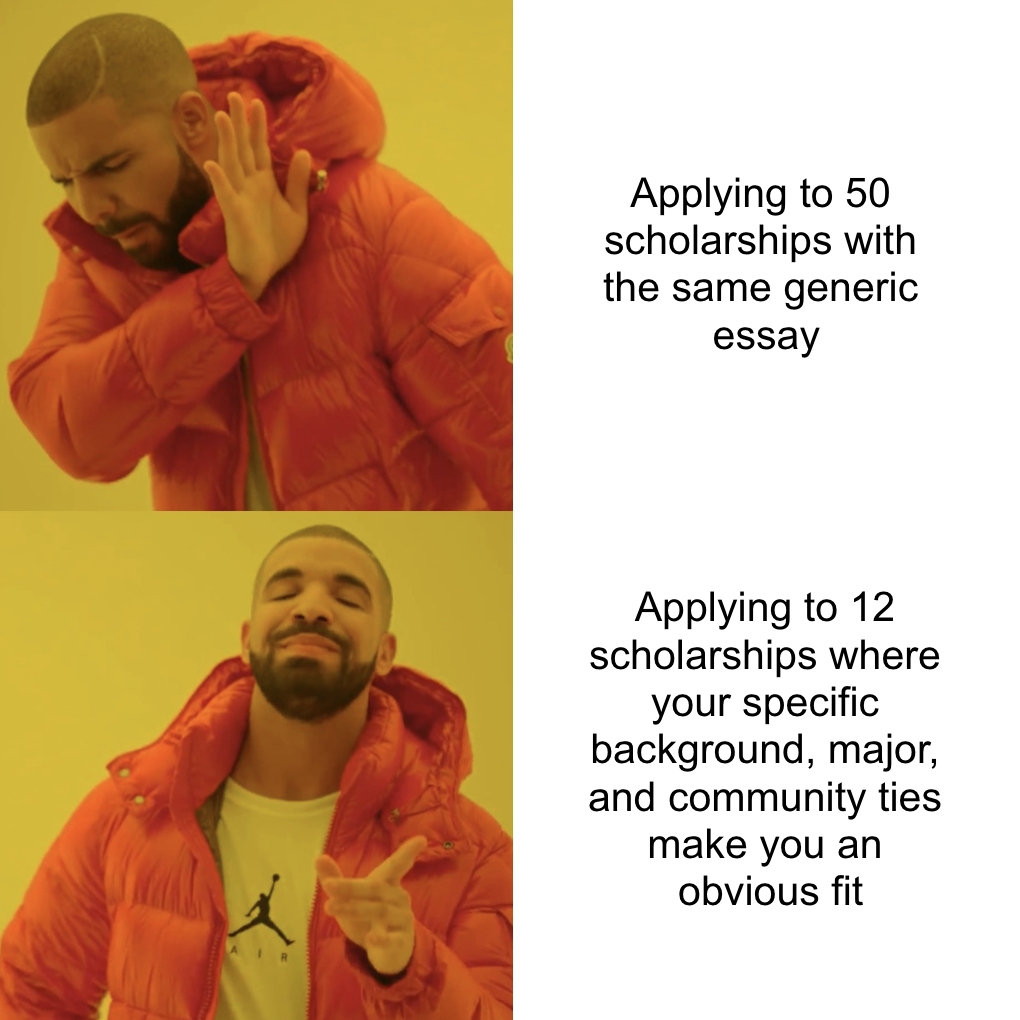
Match the essay to the organization.
Before you write anything, research the scholarship sponsor. A scholarship from a community foundation focused on civic engagement wants to hear about your relationship to your community. A scholarship from an engineering association wants to see genuine enthusiasm for the field, not a generic statement about "making a difference." The connection between your story and their mission should be explicit, not assumed.
Specificity beats volume every time.
Mentioning that you "volunteered regularly" is not the same as saying you logged 200 hours at a food pantry over three years and eventually coordinated a program that served an additional 40 families per week. The second version is memorable. It's also verifiable, which matters to committees evaluating credibility.
Answer the actual question.
This sounds obvious, but it's the most common failure mode. If the prompt asks about your career goals, the essay should spend meaningful time on your career goals — not exclusively on your background, your family, or your values. Committees notice when an applicant substitutes a prepared story for a direct answer to their specific question.

The Timeline That Actually Works
Most students underestimate how far in advance scholarship work needs to begin. Some of the most valuable scholarships — including many state-level programs and large national awards like the Gates Scholarship, Coca-Cola Scholars Program, and Jack Kent Cooke Foundation awards — have deadlines in the fall of senior year, with applications opening in the summer before. Students who find out about these programs in November of senior year are already too late.
A workable approach: start building your scholarship list and collecting supporting materials (transcripts, recommendation letter requests, activity summaries) in the spring of junior year. Spend the summer drafting and refining core essays. Hit early deadlines in September and October. Use November through February for mid-cycle and rolling deadlines.
Recommendation letters deserve particular attention here. Asking a teacher or counselor in September for a letter due in October gives them almost no time to write something strong. A request made in May or June, with clear information about what the scholarship is looking for and what you'd like them to highlight, produces meaningfully better letters.

Stacking Scholarships: How the Math Actually Works
One scholarship rarely solves the college funding problem on its own. The realistic goal for most students is assembling a combination of institutional aid, federal aid, and outside scholarships that together bring the net cost of attendance to a manageable level. Scholarships from outside organizations typically range from $500 to $5,000, with a small number of national programs offering $10,000 or more annually.
Worth knowing: many colleges will reduce institutional aid dollar-for-dollar when a student wins outside scholarships, a practice sometimes called "scholarship displacement." Before assuming that every scholarship dollar goes directly toward reducing your cost, check your college's policy. Some schools are more generous than others in how they handle outside awards — this is a question worth asking directly before committing to a school.