
Let's just say it out loud: American college is broken. It's too expensive, the value proposition is shakier than ever, and more students are starting to realize that signing up for six figures of debt to party in a dorm for four years might not be the flex it used to be.
Meanwhile, across the Atlantic, students are getting real degrees from real universities for the price of a used Honda Civic and traveling to a dozen countries while they do it.
Here's the case for packing a bag and getting on the plane.
1. American tuition has officially entered clown territory 🤡
The numbers in 2026 are genuinely absurd. According to the College Board's Trends in College Pricing report, the average sticker price for a private nonprofit four-year school is now $45,000 in tuition and fees alone. Add room, board, books, and everything else, and the full cost of attendance hits roughly $65,470 per year or about $261,880 over four years.
Going public doesn't save you if you leave your home state. Out-of-state tuition at public universities averages $31,880, pushing the four-year total past $200,000.
2. College is basically a $85,000 summer camp now
Be honest. What does the average undergraduate experience actually look like?
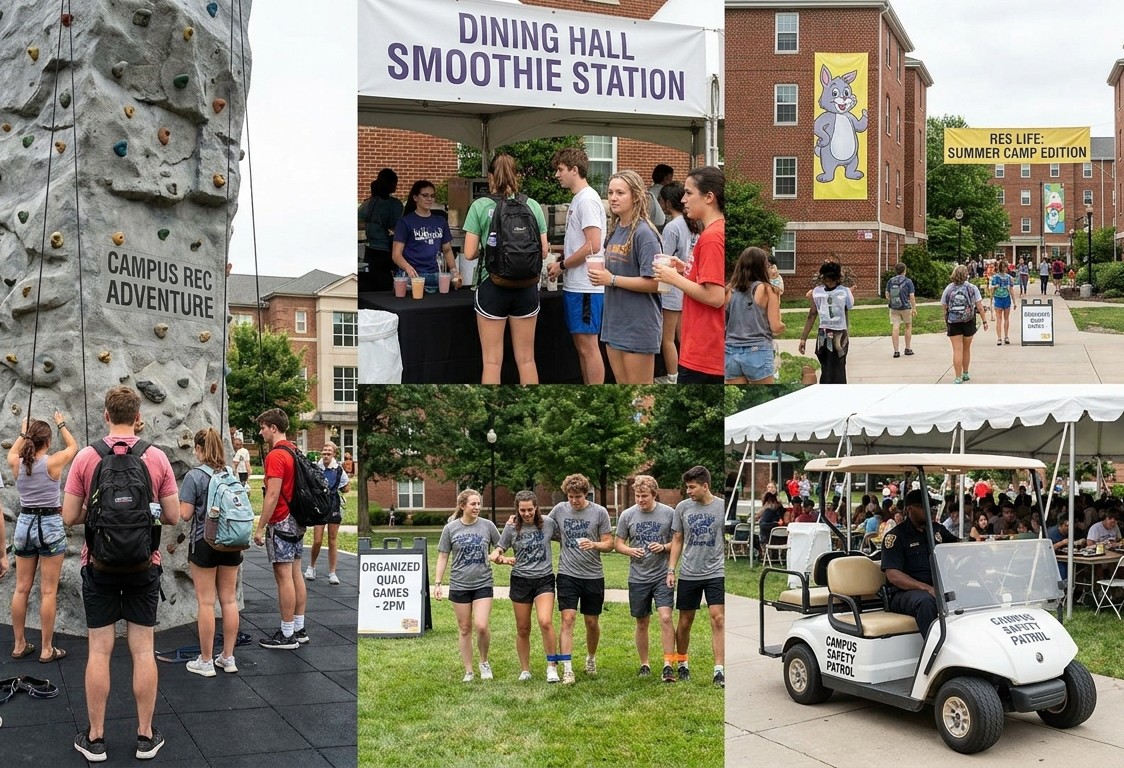
Twelve hours of class a week. Group projects done at 3am. A dining hall with a smoothie bar. A climbing wall in the rec center because the school needed to compete with the school down the road that built a lazy river. Football Saturdays. Four-day weekends. Spring break in Cabo.
It's fun. It's genuinely fun. But is it $260,000-of-your-parents'-money fun? Is it ruining-your-financial-life-until-you're-40 fun?
American universities have spent the last two decades competing on amenities, not education. You're paying for the gym, the food court, the branded hoodie, and the vibe. Then you graduate and realize the job market doesn't care about any of it.
3. AI is eating the entry-level job market anyway
Here's the elephant in the room. The whole traditional pitch for college ("get a degree, get a stable office job, pay off your loans over the next decade") is getting stress-tested in real time.
Entry-level analyst jobs are shrinking. Junior coders, paralegals, copywriters, customer service reps, bookkeepers, translators: AI is doing increasing chunks of that work, and companies are hiring fewer humans to do what's left. The World Economic Forum's Future of Jobs Report 2025 projects that 40% of employers expect to reduce their workforce in roles that AI can automate.

The degrees that used to be safe bets (business, communications, general liberal arts) are no longer automatic tickets to anything. If you're going to bet $260,000 on a credential, you should at least ask whether that credential still does what it used to.
4. You can learn AI (and everything else) anywhere
This is what's wild about 2026: the actual knowledge is free.
The cutting-edge AI research is on arXiv. The best courses are on YouTube, Coursera, and DeepLearning.AI. You can build a real application with Claude, ChatGPT, or Cursor as your tutor.
A kid with a laptop in Lisbon has access to the same models, the same papers, the same open-source tools as a kid at Stanford. The expensive part of an American degree was never the information. It was the signaling, the network, and the credential.
5. Europe costs a fraction of what America charges
Now the part that still surprises people. Most European public universities are genuinely affordable, and in several countries, free.
Tuition for (Non-EU) Students in Europe
According to data aggregated by Beyond the States, the average tuition for fully English-taught bachelor's programs in Europe is around $7,390 per year. That's less than a third of average US in-state tuition, and less than one-sixth of average US private tuition. Many European bachelor's degrees are also only 3 years instead of 4, which stacks the savings even higher.
6. Real schools Americans actually attend in Europe
This isn't some fringe option. Tens of thousands of US students are already doing this. Here are some of the schools on the well-worn American-in-Europe path:
American-style campuses abroad
If you want something closer to a traditional US college experience but based in Europe, these schools are accredited by American bodies and teach entirely in English:
- John Cabot University (Rome, Italy): Liberal arts, US-accredited, ~1,800 students.
- Franklin University Switzerland (Lugano, Switzerland): US-chartered, mandatory travel program each semester.
- The American University of Paris (Paris, France): Small liberal arts college, US-accredited, bilingual environment.
- Richmond American University (London, UK): Dual US/UK degrees.
7. Studying in Europe is like, actual growing up 👩🧑
Here's the part nobody on the college tour brochure tells you. American college is a bubble. You live in a dorm on a campus with security, a meal plan, a counseling center, and an orientation leader named Brayden. You're "independent" in the sense that your mom isn't in the next room.
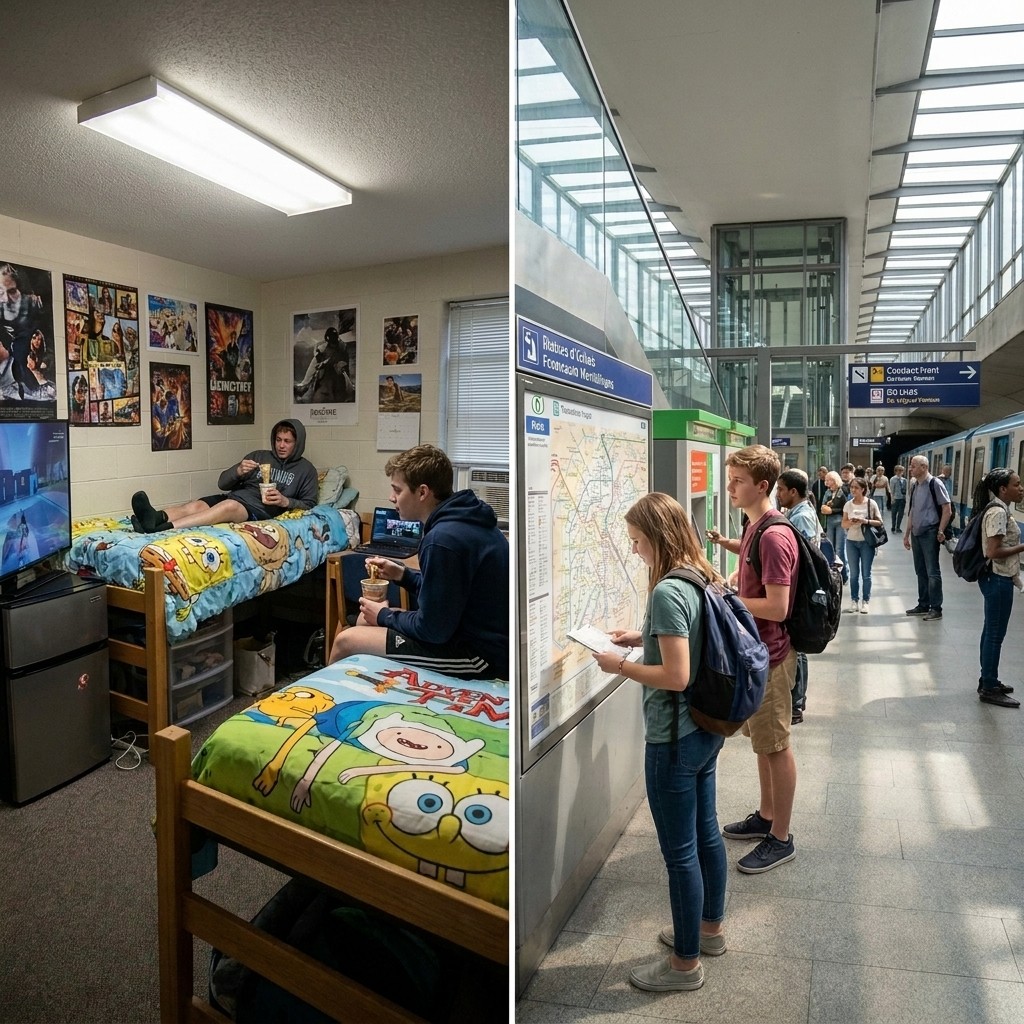
Moving to Barcelona, Berlin, or Amsterdam at 18 is a completely different animal. You figure out a visa. You navigate a foreign healthcare system. You open a bank account in a language you don't fully speak. You cook for yourself because you have to. You get lost on the metro, figure it out, and stop being scared of getting lost.
That's growing up. That's the life skill no gen-ed elective has ever taught anyone. Employers (and, more importantly, you) will notice the difference.
8. All of Europe becomes your weekend
Budget airlines in Europe are a cheat code. Ryanair, Wizz Air, EasyJet, Vueling: flights between major cities run $25–$60 round trip if you book ahead. The Eurail network covers 33 countries, and trains actually run on time.
This means "going to college" doesn't mean sitting on the same lawn for four years. It means Christmas markets in Vienna, a reading week in Morocco, and skiing the Alps for less than your American dorm laundry bill.
9. You're one flight from Asia
This is the geographic advantage almost nobody thinks about. From most European capitals, you can get to Istanbul in 3 hours, Dubai in 6, Bangkok in 10, and Tokyo in 12.
Compare that to flying from LAX or JFK, where you're trading one 11-hour flight for another. Winter break in Thailand? A gap semester in India? A backpacking summer through Vietnam and Japan? All of it is on the table in a way it simply isn't from Ohio.
Best practices before you apply
The honest caveats
This isn't for everyone. A few situations where staying stateside might be the better call:
- US law or medical school. An American bachelor's is usually still the cleaner path.
- Target-school recruiting. If you're chasing Goldman, McKinsey, or Big Tech new-grad pipelines, US network effects are real.
- Rigid majors. European admissions require you to pick a major up front. You can't department-hop like at a US liberal arts school.
- Homesickness and weather. Long, dark Northern European winters are a real thing. So is missing Thanksgiving.
Here's what it comes down to
American college used to be a deal. It stopped being a deal a long time ago, and in an economy where AI is rewriting what "entry-level" even means, paying a quarter of a million dollars for a credential-and-summer-camp combo is one of the worst financial bets an 18-year-old can make in 2026.
Europe offers a real alternative: a legitimate degree, a global network, actual adulthood, and a continent's worth of travel for less money than one year at NYU.
Worth a long, hard look before you sign the loan paperwork.