
Academic research is undergoing a major transformation in 2026, driven by technological breakthroughs, interdisciplinary demands, and a stronger emphasis on real-world impact. To the doctoral candidate starting their dissertation work in the year 2026, the methodology chapter will no longer be a procedural footnote, but the active heart of solid and effective research.
The trend in this direction is evident this year with a shift in fixation on paradigms toward agile, transparent, and technologically enhanced research. These trends are not just to be learned, but are fundamental to the creation of work that is relevant, rigorous, and future-ready in the process of knowledge creation.
This article discusses the nine transformations that will define the field of dissertation methodologies in 2026. The knowledge of these trends will assist the students in producing research that is rigorous, innovative and poised to impact the world tangibly.
Keynotes for Dissertation Methods
- Pre-registration and open data in dissertation methods are no longer regarded as best practice.
- Leaving simply the analysis behind, AI is now being used in literature synthesis, coding, and even challenging the assumptions of researchers.
- NLP and machine learning allow analysing interview, text and visual data at an unprecedented scale.
- Qualitative or quantitative purist approaches are supplanted with complex, sequential or concurrent hybrid ones.
- The ethics chapters should currently focus greater attention on the algorithmic bias, data privacy, and environmental cost of computing.
- Since the very beginning, students have to think about translational pathways in designing and, in many cases, collaborating with stakeholders.
- New forms of digital ethnography, sensor data, and crowdsourcing across the globe are defining the location of a field site in a new way.
How AI is Evolving from a Tool to a Collaborative Co-Pilot in Dissertation Methods
AI has been radically transformed to be not a passive utility but an active intellectual partner in research design. Students are using it to stress-test methodologies, which force the LLM to detect the weaknesses in sampling or interview questions in dissertation methods, before the data collection.
Students often use AI to test methodologies and identify weaknesses in sampling or interview questions before starting data collection. While AI can highlight potential issues, experts at a trusted UK dissertation writing service bring experience that AI cannot replicate. They refine research methods and craft literature reviews that connect theories across disciplines with depth and clarity, turning raw research into a polished dissertation.
AI is used in analysis to code large qualitative data sets, although it is up to the researcher to refine the results and give them a thorough contextual understanding. This partnership must be clearly described in the methodology. Specifically, researchers should explain how they engineered AI prompts. Additionally, they must detail how they maintained human scholarly oversight throughout the process. This ensures transparency and accountability in the research design.
9 Transformative Changes in Dissertation Methods Every Student Must Know
The dissertation methods have ceased to be a fixed template but have turned out to be a dynamic and strategic pillar of contemporary research. Students in 2026 will navigate a research landscape defined by AI's power, complex digital ethics, and an uncompromising need for transparency and real-world change.
These 9 changes involve working with AI as a co-pilot and creating agile and impactful scholarly works, which are crucial in creating credible, rigorous, and future-thinking scholarship. Lack of adaptation may make a dissertation technically valid and essentially outdated in a dynamic academic ecosystem.
1. The Imperative of Methodological Transparency & Open Science
Transparency is now a necessity and not an alternative. To prevent any of this, you have to pre-register your study, publish your data and code, and provide a record of this. It is this confirmable openness that renders credibility and rigour in contemporary research.
Eliminating the Hidden Processes in Methodology
The normative, opaque methodology chapter is no longer present. Credibility today is established by showing proven transparency and not by giving you a good description of how you do it. The academic community is now responding to the replication crisis by expecting research to be entirely open, verifiable and reproducible throughout. Your work must be an open book.
Core Open Science Practices for Dissertations
To achieve this new standard, you have to take action to use core Open Science protocols. This entails three negotiating imperatives, which are non-negotiable:
- Avoiding the need to analyse and present your study design and analysis plan on a public registry beforehand.
- It is best to store your anonymised data in a reputable warehouse.
- Publicising all the code of analysis and research materials.
Building Research Integrity in the Dissertation Methods
This institutional pressure is the direct reaction to the failure to recreate key discoveries across disciplines. The solution established is transparency, which is a direct counter to such practices as p-hacking and HARKing. Open practices will turn your dissertation into more than a standalone argument on its own, and it will establish the validity and effectiveness of your work.
2. Agile and Adaptive Research Designs
These approaches are inspired by iterative design thinking and enable the research question and methods to develop as the research progresses and findings are shared in real-time. This especially applies in disciplines that are dynamic such as technology studies or responding to a crisis.
Although the chapter on the methodology is rigorous, it could include a major pathway followed and then outline predetermined points of adaptations and decision-making procedures in the event of a pivot. This shows a high level of sophistication that research is a discovery and not a verification exercise.
3. AI as a Collaborative Co-Pilot in the Research Dissertation Methods
AI has become a dynamic intellectual collaborator (not a mere tool), and it can aid in formulating, testing and improving your approach. It can stress-test research designs and analyse large datasets.
Moreover, it can uncover valuable insights. However, these insights remain subject to your critical scrutiny. Therefore, researchers must carefully evaluate and interpret the results. Now you need to state the collaboration in your methodology in a clear manner to be able to show both innovation and academic rigour.
The Evolution of Dissertation Methods from Tool to Intellectual Partner
The use of AI in dissertation methods has radically redefined its role and value. Instead of acting as a passive tool to support tasks like exploratory data analysis, it has become a proactive part of the research process.
Moreover, in 2026, its true value lies not in automation but in intellectual augmentation. This involves engaging in a dynamic dialogue that refines and challenges a researcher’s thinking from the very start of a project.
Stress-Testing and Refining Methodological Design
The most effective implementation is the application of AI, in particular, LLMs, to critically question your suggested methodology. Before gathering information, you can ask these models to play devil's advocate and challenge them to find any possible confounding variables, logical errors or ethical shortcomings in your design. This will enhance the structure of your study because it will effectively counter the weaknesses that would otherwise emerge at the peer review stage.
Augmenting Literature Synthesis and Qualitative Analysis
Two fundamental academic activities, literature navigation and qualitative data analysis, are dramatically improved with the help of AI. It can map conceptual networks across thousands of studies, revealing hidden links and gaps. In qualitative research, it also enables rapid initial coding of large text datasets in a fraction of the time. More importantly, the rise of the human in the loop model places the researcher at the centre of the process. Here, expert judgment refines AI outputs and ensures that interpretation and cultural context are not lost to algorithmic bias.
4. "Big Qualitative Data" and Computational Humanities
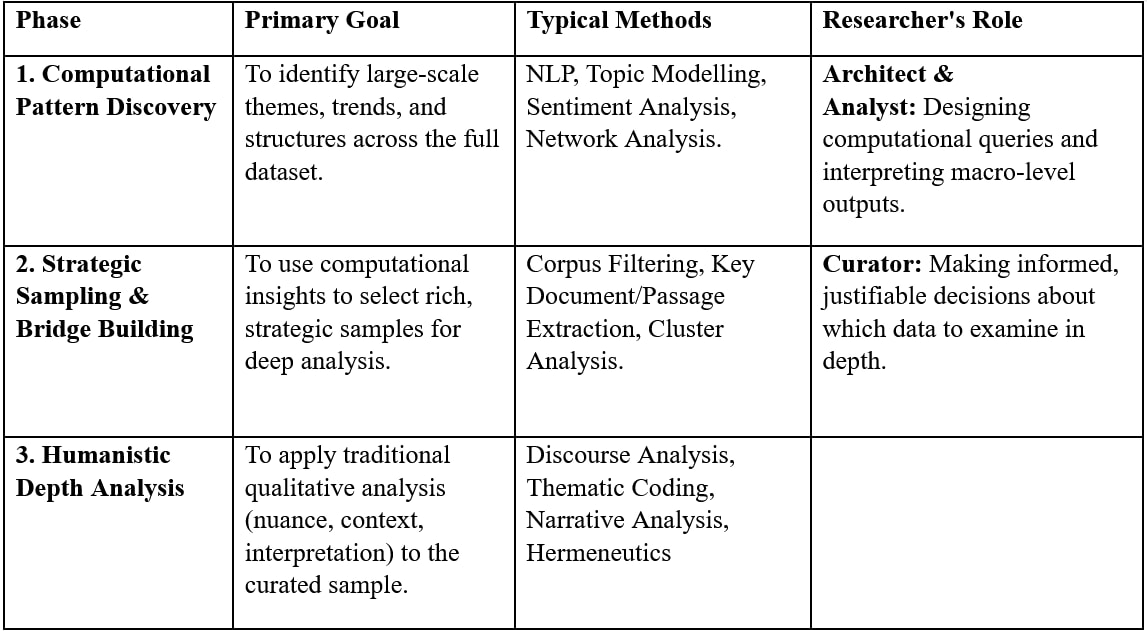
The release of a plethora of qualitative data, in the form of digital archives and large collections of interviews, has made purely manual analysis inadequate. This has brought about the age of Computational Humanities where we have replaced humanistic inquiry with scale management using digital tools. The key challenge and innovation now lie in strategically combining computational breadth with traditional analytical depth to produce truly robust findings.
Digital Techniques for Scalable Data Analysis
With data sets of inconceivable scale, scholars are employing computational methods to chart out the analytical landscape. Methods such as Natural Language Processing (NLP), topic modelling, and network analysis allow scholars to analyse millions of words or thousands of images efficiently.
These tools help reveal large-scale patterns, themes, and relationships that would be difficult to identify through manual analysis alone. As a result, researchers gain a broader and more systematic understanding of complex datasets. It is a stage of pattern discovery on the macro level, an overview of the whole corpus with a data basis.
The Macro-Micro Bridge: Integrating Scale with Depth
It is not a replacement for close reading but an augmentation of it that defines the trend. The computational distant reading phase directs and educates purposeful and sensitive close reading.
A scholar may use topic modelling to identify a major thematic cluster across a century of novels. Based on these results, a carefully selected sample of texts can then be examined in depth. This is followed by a descriptive narrative analysis that adds contextual meaning to the computational findings.
This bridge should be clearly explained by the dissertation methods - why the computational outputs were required to choose materials to be analysed deeply qualitatively and how the two levels of inquiry are informative about one another.
5. Hybrid Methods: Sophisticated Integration as Standard
Gone are the days of merely having quantitative research and qualitative parts in a study. By 2026, complex hybrid methods will be the norm. Each phase actively shapes the next, creating a responsive and integrated research process. This deep, recursive approach ensures methods reflect and inform each other effectively. This dissertation method goes beyond parallel streams of data to establish a dynamic sequential research dialogue.
Strategic Iteration in Hybrid Research Design
The essence of contemporary hybrid dissertation methods lies in a deliberate, step-by-step connection. In this approach, the results from one phase directly influence the design of the next. Moreover, each subsequent phase actively shapes and refines the earlier findings. This creates a dynamic and responsive research process that adapts to emerging insights.
This allows an iterative, responsive research process that is able to respond to and explore the unexpected in real time. This methodology is driven by a pragmatic philosophy and therefore places the research question ahead of rigorous methodology.
- Intentional Sequencing: The sequence of dissertation methods (e.g., QUAN-QUAL or QUAL - QUAN) is intentionally selected to develop knowledge.
- The "Hinge Point": A well-established point whereby the discovery in the former is the defining moment of sampling, question or interest of the latter.
- Iterative Refinement: It can reiterate itself, with the insights of the later phase informing the re-analysis or re-contextualisation of data of the earlier phase.
Justifying and Documenting the Integration
The credibility of a hybrid design depends on a justification expressed clearly and well-documented in the methodology chapter. This is done not only through stating what you have done, but also the reason why there was a need to integrate and the way it was done rationally. This involves:
- Philosophical Grounding: The worldview (e.g., pragmatism) should be described clearly to justify the combination of methods to most efficiently deal with the research problem.
- Procedural Transparency: The presentation of a flowchart in detail, in the form of a visual representation of the dissertation methods which points out the hinge point and data flow.
- Analytic Description: The description of how exactly the data at one step is converted into the operational guide to the next (e.g. how particular statistical clusters made participants available to the interview).
6. Embedded Ethics for the Digital Age
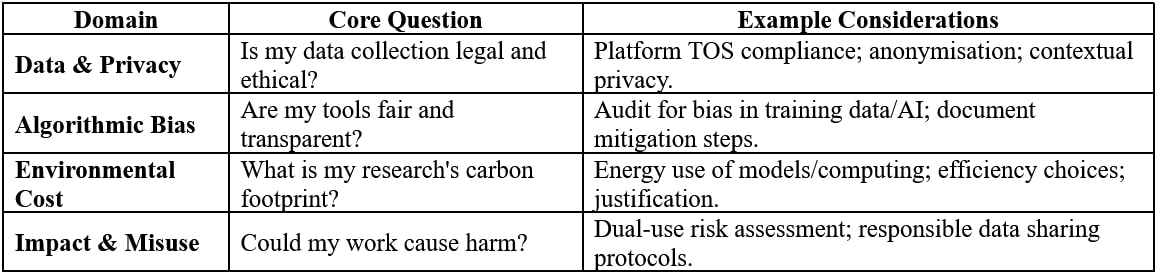
Dissertation methods have a broadened scope of ethical considerations that are beyond the traditional consent forms. The modern methodology needs not only a separate subsection of the novel ethical quandaries of digital and computational research, but also your approach to it.
Embedded ethics requires researchers to actively consider online privacy, algorithmic fairness, and the environmental impact of their tools.
7. Dissertation Methods Designed for Implementation & Impact
By 2026, research methodologies will focus much more on practical application rather than purely theoretical design. Consequently, researchers are incorporating participatory approaches and implementation science.
This ensures that the findings can be applied directly within communities and industries. As a result, dissertation methods become more relevant and impactful. The stakeholder participation now starts with the research design phase which makes it more relevant and useful.
Key Points:
- Consider the stakeholders' engagement mechanisms during the onset of the research design.
- Use implementation science frameworks to bring the findings closer to practice.
- Create a precise impact and knowledge-mobilisation strategy to satisfy the current funding demands.
8. The Decentralised and Globalised Field Site
Contemporary studies and dissertation methods no longer need geographical areas, but digital and virtual ones. Such technologies as VR, virtual communities, and satellite data allow participation worldwide. The methodologies should guarantee context, quality of data and integrity.
The Evolution of the Digital & Decentralised Field Site
Researchers use virtual reality work environments, web-based communities, satellite imagery, and Internet-of-Things data feeds to collect information from diverse populations.
Consequently, this approach enables more inclusive participation and broader perspectives. As a result, dissertations can better reflect real-world dynamics. Moreover, these digital tools expand the scope and depth of modern research.
Methodological & Ethical Considerations in Dissertation Methods
Digital work in decentralised areas presents novel issues regarding reliability and the quality of information and ethical accountability. Researchers must develop strategies in dissertation methods to build strong relationships with participants over the internet.
At the same time, they need to ensure that the collected data remains rich and multifaceted. Moreover, the integrity of the research depends on following clear ethical guidelines. For example, obtaining informed consent, protecting privacy, and using platforms responsibly are essential for trustworthy results.
9. Visual & Multimodal Methods Take Centre Stage
As the digital way of communication prevails, studies that focus on text analysis alone are usually not complete. There is an increase in multimodal dissertation methods which are concerned with the production of meaning via image, video, sound, layout and use of text. This may include an analysis of Instagram posts visually, video elicitation in interviews, or sonic ethnography.
Conclusion
The 2026 dissertation methodology will be a living, breathing document that traces the path through a complicated research ecosystem. It values openness rather than secrecy and encourages teamwork between humans and machines instead of working independently. It also prioritises contribution over mere observation.
By following these nine trends, including open science and AI co-pilots, you can make your research stronger and more effective. Top-notch dissertation writing services in Manchester can help you apply these methods the right way. Focusing on practical implementation and exploring decentralised fields also puts your work at the forefront of modern research.
The way you have gone about it is more than a chapter; it is a kind of manifesto of a new, rigorous, and effective scholarly practice. Though when you are preparing your study, you will want to consider not only the question: Is this method sound? but will this way be ready for the future of knowledge? The best dissertations this year will say yes resoundingly to the question.
Frequently Asked Questions about Dissertation Methods
Why is the dissertation methods chapter important in research?
The chapter on methods is the main part of any dissertation as it describes the way in which the research took place. It specifies the research design, the methods of data collection, and the methods of analysis, which are transient and reproducible. A clear methods chapter demonstrates the rigour of the study and allows readers to evaluate the credibility of the findings. It also explains why specific methods were chosen and how they align with the research questions and objectives. The absence of a powerful methods chapter can cast doubt on the validity of even enlightening findings or make them unreliable.
How is data analysed in dissertation research?
In dissertation methods, data analysis entails the arrangement and study of obtained data to respond to research questions. Researchers analyse quantitative data using statistical tools, models, and software to identify patterns, relationships, and significance. Coding, thematic analysis, and narrative evaluation are all used in interpreting qualitative data to reveal hidden meanings and insights. Mixed methods research is a method that integrates the two to come up with holistic knowledge. The analysis depends on the research design, nature of data and research objectives. Clear documentation of the analysis process increases transparency and credibility.
How do you ensure validity and reliability in dissertation methods?
Validity ensures that the research measures what it is intended to measure, while reliability guarantees that the results remain consistent across repeated applications. To ensure proper validity, researchers are keen to define terms, apply relevant instruments, and rely on relevant analysis techniques. Researchers ensure reliability by using clear procedures, conducting pilot tests, and maintaining consistent data collection methods. Triangulation- reliance on more than one method, source, or perspective will enhance validity and reliability also. Transparency, ethical considerations and documentation also contribute to the credibility of the research findings.